About

I am a current student at University of East London, studying Graphic Design and Printmaking. Art has been my passion ever since I discovered a pencil. I can’t place myself to a specific genre but if I absolutely had to it would be somewhere in between Graphic Design and Illustration. As a young artist I am still trying to define my style of work, so far I would describe it as accurate and delicate. I like to take great care of each piece and make sure it is produced to high quality or else it is not worth exposing to the world, I am definitely a perfectionist when it comes to my own work. Living in digital age it is hard to ignore all the amazing software, however I believe that handmade pieces are so much more valuable and precious compared to digital. It takes great determination to producing a handmade piece, making unintentional mistakes part of the work often leads to uniqueness, such work cannot be re produced which makes it very admirable. I guess I try to re bell against all the brand new techniques on purpose, because I like spending time on solving problems that could be corrected in no time on computer software. I get my inspiration from quite literally everywhere

Thursday

Mark Titchner: Three Minute Wonder

Sunday

David Mushegain: Don't Call It Cool

During the summer holiday I have visited Paris, and thought it would be a crime not to visit at least a few exhibitions during the short time I was there. 
This was a single photographers exhibition held in a well known spot to the younger crowd called Colette, this place is popular for selling exclusive streetwear brands, unique designer clothing as well as art and design books. This three floor space is like a melting pot of young culture, with a small gallery space tucked in right at the top of it all. I thought the atmosphere was perfect for this type of exhibition. As I was admiring these photographs I realised there was actually no information about who the people were and what this exhibition was all about until I reached the very end of it, where a small table stood with all the information leaflets. It seemed like the photographer wanted the viewer to make their own assumptions on who the subjects were and why they were photographed. And I was right, David Mushegain uses photography to document the people he meets on daily basis, people he finds fascinating and beautiful. 
For me the photograph that stood out most was with a man covered in tattoos, because more then likely that each piece of art on his body has a story behind it. I find it very interesting the way some of us choose to record certain events/ memories through out our lives in text and image on our own bodies. Its great the way he uses black and white photography to focus viewers concentration on the persons features, faults and perfections.
Over all I think this was a great exhibition, Mushegain has managed to capture each persons personality in one shot. Its also great to come across someone who can see each individual for what they really are, unique, in their own way beautiful human beings. 

David Mushegain, Unknown 2010-2011

David Mushegain, series of photos 2010-2011

David Mushegain, series of photos 2010-2011

Friday

Erika Lakatos: Roman Icons, New York - Budapest 1996 - 2011

This was another exhibition at the Hungarian House of Photography, single artists exhibits. All the work was displayed very simply, due to the complexity of the art itself. As a viewer I didn't feel informed well enough what the work was about, I had to do my own research on the techniques used to produce the images. The photographer works with polaroid images and applies a fine art touch to them by enlarging photgraphs and applying paint using a colourful pallet. Even though Lakatos work didn't appeal to me and left me feeling confuse, I still quite like the idea of working and re-arranging photographs by using different type of media on the image, creating unusual effects. Perhaps its something I could experiment with over the summer. My favourite piece of work out of the whole set was the image below, mostly because of its beautiful earthy colour scheme and soft marks of distortion. 

Erika Lakatos Untitled, 1996-2011

Sunday

Hungarian House of Photography: Róbert László Bácsi

This exhibition was showcasing works of five different Hungarian photographers, Róbert László Bácsi, András D. Hajdú, Dénes Mártonfai, Simon Móricz and Márk Simon, who reflect on social and political issues through Fine Art Photography. This exhibition was based on the top floor of a very old building, which is a photography gallery. Works were clearly displayed between three rooms/corridors, I felt like the best pieces were shown to the viewer first. As an observer I felt a little confused about some works as the text explanations around the gallery were in Hungarian, but I think most photographs speak well for themselves. 
I particularly admire Róbert László Bácsi photographs, who gives the viewer an insight into gloomy and grey Armenia. All of his photographs look very interesting, because of their dull and misty atmosphere. I have never been to Armenia myself but it is kind of what I imagine it to be like, and the photographer has done a very good job at visually communicating the county's state to the viewer. 
These photographs are not the kind you glance at and think "oh that's a lovely picture", they show us a country that used to be part of Soviet Union and who is still facing difficulties to this day. I think works like this need to be exposed a little more, so we get a better insight into smaller countries around the world. 


Saturday

Mysterious Al

This is a solo exhibition by Mysterious Al at the Stolen Space gallery, the exhibition space is not very big but its perfect for this style of work as the gallery is well known for hosting underground style illustrators and graphic designers. all works are thoughtfully laid out around the space, flat pieces were hung on the walls and there were two installations, a colourfully pained broken down garden shed and a small prayed space with crosses made out of wooden branches, candles, spray paint cans and an open bible with cut out pages with a marker pen placed inside. The whole exhibition is vibrant and humorous, which creates a great atmosphere to be in as a viewer. I thought the bible piece was quite successful, as it was an artists way of presenting his strong believes in graphic art by creating almost a shrine for his tools. Wood masks also really stood out for me, because of the way they were composed, layers of wooden pieces painted and carefully placed on top of each other to create a three dimensional effect. I would really like to take this technique into practice and make something similar to these masks in the future. 
Mysterious Al  Masks 2011

Mysterious Al  Pisstake 2011

British Art Show 7

This week I went to see a British Art Show exhibition which was based at the Southbank Centre. I think this is a perfect venue to host an exhibition filled with contemporary British art work, as the Southbank Centre has been used for Art's purposes since 1951 and to this day it looks like a modern piece of architecture.
Most art work's displayed around the exhibition spaces were very difficult to grasp, I felt confused and misguided for most of the time. Perhaps I am just not as open minded as I thought...However there were a few pieces that caught my attention, a video screening by Christian Marclay The Clocks and Luke Fowler Grammar for Listening (part 1). I was quite surprised of myself, as I don't usually find video pieces that interesting, but these ones were more like film.

Christian Marclay The ClocksThe screening was based in a dark room, where a 24 hour video was projected on to a big white wall like a small cinema. As the work is 24 hours long at first I was not sure what was going on on the screen, but after a few minutes I have started to realise that the video is created out of short clips from various film fragments which indicate a certain time. Basically what ever time it is right now, that will be the time in this video.
Watching this piece was incredibly interesting, I sat there for some time while hundreds of different narratives were flickering before my eyes. I think that's what makes it so interesting and timeless, because your mind wants to know what will happen in the next minute so you want to watch more and more. It seems that Marclay is trying to communicate the importance of time and how it can fly by without us noticing, while constantly being reminded about it.
From reading reviews and watching a BBC news report on Christian Marclay's The Clocks, this piece has left a very positive impression on critics and the public itself, everyone is recommending to take a peak at this brilliant work of art! Personally I couldn't agree more, seeing a small part of this film has left me mesmerised, I wanted to sit in that very uncomfortable chair for the whole of 24 hours.
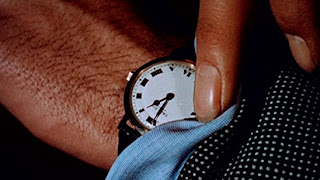
Still from Christian Marclay’s The Clock, 2010
Luke Fowler A Grammar for Listening (Part 1): Again the video was screened in a dark room with an even smaller screen, the film footage was shot with a 16mm camera which gave it lovely rounded edges and a vintage crackle look. The viewer is supposed to observe the video and listen to a separate sound file, which automatically encourages to question the communication between listening and looking. Personally I was overwhelmed with the calm and unnoticeable everyday noises that were complimenting the peaceful imagery on the screen, mostly because they were turned up to a very high volume which I was not used to. Sitting in the room became very uncomfortable due to the build up of the sounds, which was very strange because usually I barely notice them in my every day life. On the other hand the film was beautifully composed and I particularly enjoyed that part of the work.
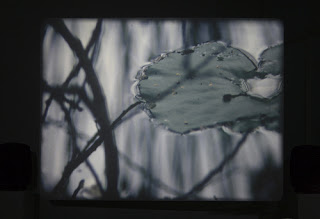
Still from Luke Fowler's A Grammar for Listening, 2009

Monday

John Stezaker

I have recently visited a single artist exhibition of John Stezaker at the Whitechapel Gallery. This artist composes collages by mainly using film stills combined with vintage postcards, the work is simply constructed but comes across very complex to the viewers eye. I myself was inspecting some of the pieces for at least few minutes, as the artist managed to combined two different images into one without any visible lines of collage. It felt like an optical illusion of the space and angles within a photograph. All the imagery used in Stezaker's work is recognizable from our every day lives and the viewer is there to observe and absorb the fascinating mix of old photographs and modern art work.
Looking at the individual series, the Untitled pieces of various film star images have been cut diagonally in half and carefully balanced together to create a distorted portrait. I thought this particular series is one of the most successful works. I think he was trying to show the public how simple it can be to make something beautiful ugly and distorted, the actresses back in them days were flawless and no one ever thought to imagine them looking this way. Another great series would be Mask, where he again uses film stills only this time placing postcards of very impressive nature imagery on top of the portrait. I see it as a comparison of beauty, a subliminal message of natural beauty within a woman. Not forgetting to mention the the precious worn out colours that vintage postcards hold, it really adds character to these works. I may be wrong about the message behind Stezaker's work, but that is how I have interpreted it after seeing the exhibition.
Over all this was a great exhibition to start my academic year with, it might be one of the best exhibitions i have been to in some time. Collaging is something I like to do myself and I have picked up a great deal of inspiration from John Stezaker's work, especially the photography part of it!

Mask XXXV 2007 (collage)
Untitled XX  2007 (Film Portrait Collage)